

Is Your Mature Field Finished, or Just Under-Mobilized?
A quantitative screen for whether historical development left recoverable oil insufficiently mobilized.
A mature field can look finished for several different reasons.
The reservoir may be substantially depleted. The remaining oil may be technically inaccessible or economically unattractive. Existing wells may already have contacted the most valuable rock.
But there is another possibility:
The field may have been developed with limited reservoir contact using the technology, data and economics available at the time.
That possibility does not justify drilling. It justifies a disciplined re-screen.
PINN AI’s position
No development pathway is inherently superior. The defensible choice is the one supported by reservoir evidence, project economics, physical constraints, and the operator’s capital strategy and operating model.
Long-lived production is evidence, but not an answer
An older vertical well that produced only 38,000 to 50,000 barrels may appear marginal when viewed only through cumulative production.
Its productive life may tell a more interesting story. If it produced for decades, it may demonstrate durable reservoir deliverability even though the original wellbore contacted only a limited portion of the reservoir.
That history can support a redevelopment question:
What did the old wells prove about recovery density, and how might a modern development configuration contact the reservoir differently?
Historical production alone cannot answer that question. Pressure, remaining saturation, permeability, net pay, natural fractures, compartmentalization, completion quality, interference and operating history can all change the conclusion.
Regulatory spacing is not reservoir drainage
A 40-acre regulatory spacing or density unit does not establish that a vertical well effectively drained 40 acres. Actual drainage depends on the specific reservoir and completion.
For an illustrative screen, suppose the effective drainage area of a historical vertical well is 15 acres. A circular 15-acre footprint has an equivalent radius of approximately 456 feet and a diameter of approximately 912 feet.
This is an assumption to test, not a field fact.
Reservoir contact and oil mobilization are linked, but they are not the same metric
Reservoir contact describes how much rock the well and its effective stimulation reach. Mobilization describes whether oil in that contacted rock can move through the reservoir and into the wellbore under the prevailing pressure, saturation, relative-permeability and fluid conditions.
A well can have limited contact and therefore leave large volumes beyond its effective drainage footprint. It can also contact reservoir rock without creating enough durable conductivity, pressure support or displacement efficiency to mobilize much of the oil in place.
That distinction matters because the redevelopment answer may not be a new horizontal or vertical well. If the existing casing retains pressure integrity and the reservoir evidence supports it, a modern refracture, recompletion or other stimulation treatment may expand effective contact and mobilize additional oil through the existing wellbore.
The correct question is not simply, “How much rock did the old well touch?” It is, “How much oil could the original development effectively mobilize, and what intervention could change that result?”
A one-mile lateral can be compared with historical drainage footprints
For screening purposes, a 5,280-foot lateral can be represented as a contacted corridor. The corridor width must be supported by reservoir and completion evidence; it should not be treated as synonymous with fracture length.
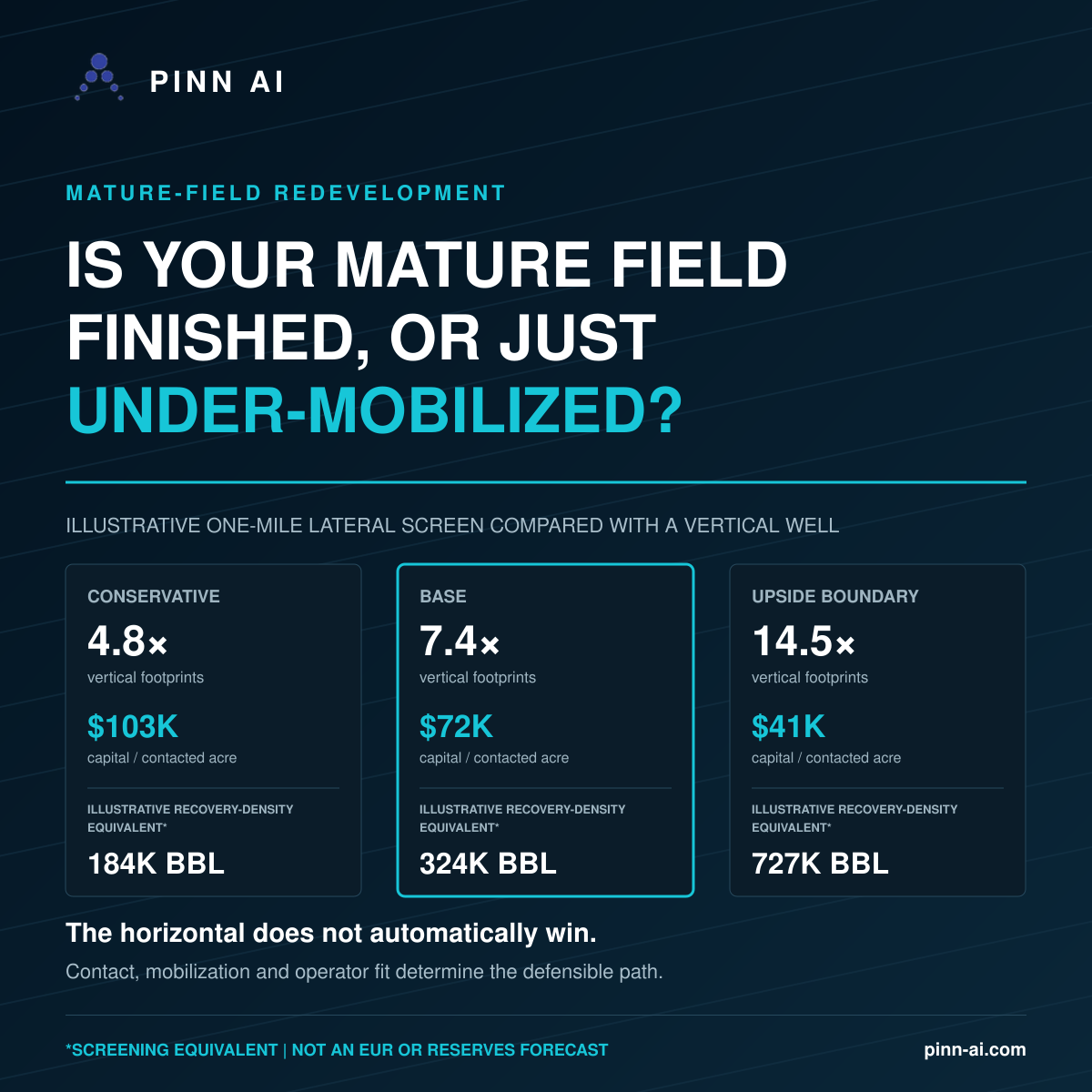
The table below shows how three sets of assumptions change the result.
| Illustrative screening case | Conservative | Base | Upside boundary |
|---|---|---|---|
| Effective vertical drainage | 20 acres | 15 acres | 10 acres |
| Horizontal effective corridor width | 800 ft | 912 ft | 1,200 ft |
| Horizontal contacted area | 97 acres | 111 acres | 145 acres |
| Vertical drainage-footprint equivalents | 4.8× | 7.4× | 14.5× |
| Historical vertical recovery used | 38,000 bbl | 44,000 bbl | 50,000 bbl |
| Historical recovery-density equivalent | 184,000 bbl | 324,000 bbl | 727,000 bbl |
These are not EUR forecasts.
The recovery-density equivalent extends historical vertical recovery across an illustrative contacted area. It does not account for depletion, pressure loss, remaining saturation, interference, completion efficiency, acceleration, technology uplift or economic limits.
The horizontal does not automatically win
Contact geometry is only one part of the decision. Capital intensity can reverse the apparent answer.
Assume an illustrative modern vertical cost of $1.5 million and a horizontal cost range of $6 million to $10 million. Dividing capital by the illustrative contacted area produces a balanced result:
Under the conservative assumptions, the vertical is less capital-intensive per contacted acre. Under the base and upside screening assumptions, the horizontal may contact more reservoir per dollar.
Neither result determines the better well.
A vertical program may better fit an operator seeking lower individual-well exposure, simpler execution, lower maintenance, shallower decline and long-duration cash flow. A horizontal program may better fit an operator seeking greater contact, faster resource conversion and fewer surface locations.
The reservoir determines what is technically possible. Operator fit determines what is commercially appropriate.
What can affect the redevelopment case?
- Pressure depletion or remaining saturation is worse than assumed.
- The historical production belongs to a shared reporting unit and cannot be defensibly allocated to individual wells.
- The target is compartmentalized or laterally discontinuous.
- The assumed drainage area or effective horizontal corridor is overstated.
- Parent-well depletion or offset interference reduces expected performance.
- Completion, water-handling, artificial-lift or integrity costs overwhelm the contact advantage.
- Lease, unit, depth, spacing or surface constraints prevent the proposed geometry.
- The operator’s capital model, execution capability or preferred cash-flow profile favors a different development path.
The opportunity is in finding the fields that deserve the work
Mature producing basins contain large numbers of assets developed across different technological eras. Some are depleted. Some are constrained. Some will not support additional investment.
Others may contain remaining opportunity that becomes visible only when historical production, reservoir evidence, geometry, completions, rights and economics are evaluated together.
That is where PINN AI can help.
Not by assuming an old field should be redeveloped. Not by beginning with a preference for horizontal or vertical wells. And not by converting a screening case into a forecast.
PINN AI helps identify which mature-field opportunities deserve deeper review, which assumptions control the outcome, which development paths fit the reservoir and operator, and which opportunities should be left alone.
PINN AI
Make the assumptions visible. Let the evidence choose the path.
Technical references and scope
This article presents an illustrative screening framework, not reserves, EUR or investment advice. Reservoir-specific engineering is required. For broader technical context, see the Society of Petroleum Engineers/JPT discussion of extended laterals and hydraulic-fracturing redevelopment in tight fractured carbonates, and the U.S. Department of Energy archive of a mature-field redevelopment strategy study.
Could your mature field be under-mobilized?
Bring us the field, the available evidence and the operating constraints. We will help determine whether it deserves a quantitative re-screen and which development paths, if any, warrant deeper review.