

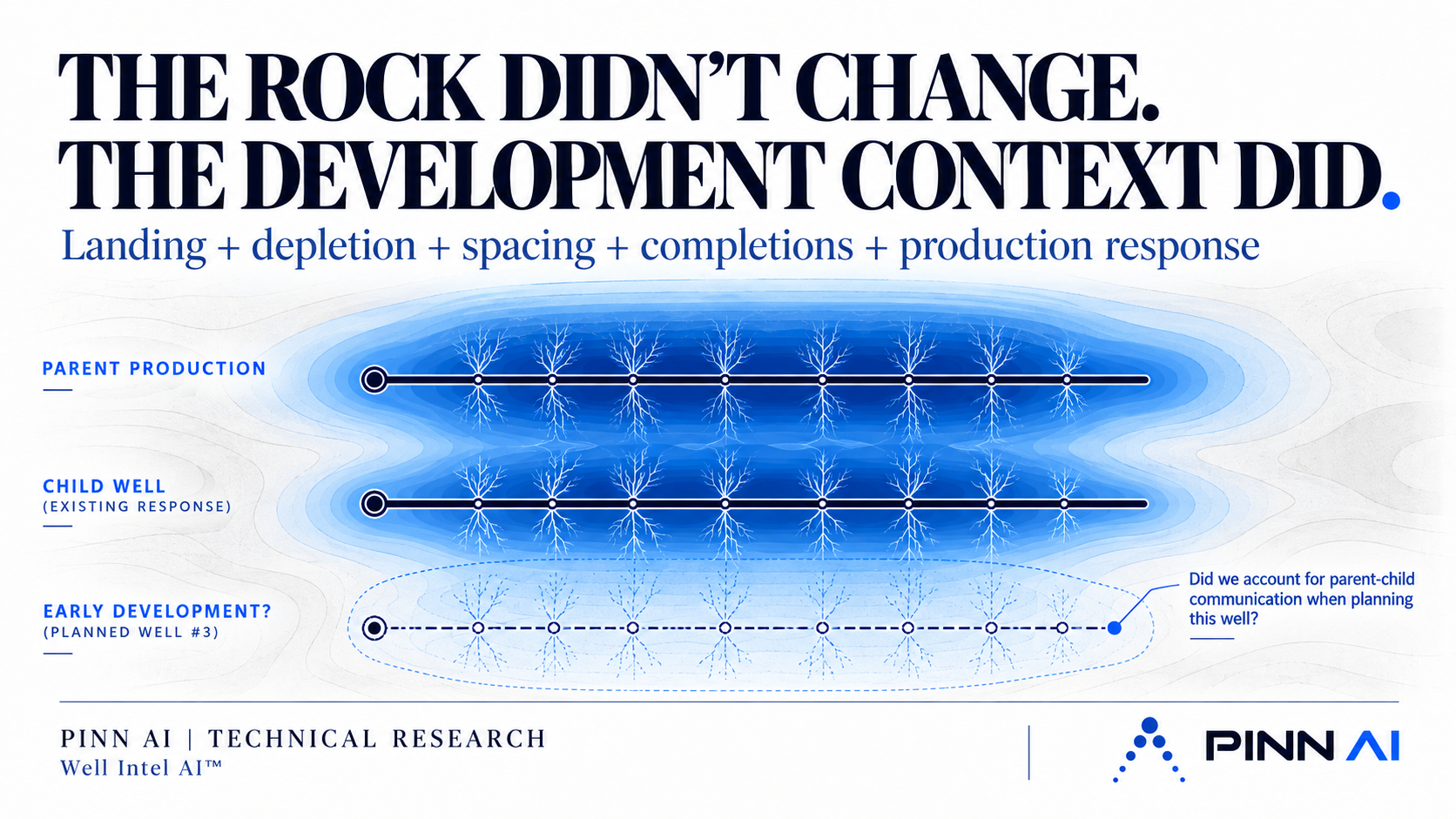
Oil and gas development has become very good at labeling rock.
Formation tops. Landing zones. Benches. Porosity. Water saturation. Net pay. Brittleness. Pressure.
All of them matter.
But none of them, by itself, answers the question operators ultimately have to answer:
That distinction becomes more important as a field matures. Two wells can be landed in the same named formation, separated by what appears to be a reasonable distance, and completed using broadly similar designs. Yet their outcomes can be materially different.
The reason may not be that one geological interpretation was simply wrong. The surrounding reservoir may no longer be the same reservoir.
The reservoir has a memory
Production changes pressure. Pressure changes effective stress. Stress changes fracture behavior. Existing fractures, depletion shadows, parent wells, offset stimulation and pressure communication can all alter how a new well interacts with the rock around it.
Recent work in the Midland Basin illustrates the problem. A 2026 SPE Journal study evaluated production-induced pressure depletion and geomechanical stress changes in infill development. For wells completed from 2018 onward, the study found that spacing and depletion were important productivity drivers alongside completion parameters and reservoir pressure. The coupled simulations also indicated that depletion history and timing can affect fracture behavior in subsequent child wells.1
A separate 2026 Midland Basin case study approached the problem from another direction. Child-well performance can degrade relative to earlier parent analogs even when wells are landed in the same formation and use similar completion designs. When depletion is ignored, development decisions can inherit optimism from analogs created under different reservoir conditions.2
The lesson is not that unconventional development has become unpredictable. The lesson is that the development problem has become multidimensional.
Good rock is necessary. It may not be sufficient.
Consider the traditional landing-zone question. An operator identifies a target formation and evaluates gamma ray, resistivity, density, neutron, sonic or other available measurements. Petrophysical interpretation may identify intervals with favorable porosity, saturation, thickness or mineralogical characteristics.
That work remains essential. But now add another set of questions.
What has already been produced nearby?
How long have the offset wells been producing?
What pressure depletion may exist?
Where are the neighboring laterals?
How much vertical separation exists between targets?
How did nearby wells behave during their first 12 or 24 months?
Were they completed similarly?
Did different completion generations produce materially different results?
Does production support what the rock appears to suggest, or contradict it?
Those questions can change the development decision.
Production is not simply the economic result
Production is often treated as something that enters the workflow after the subsurface work has already been completed: find the rock, design the well, forecast production, run the economics.
But historical production can also function as reservoir evidence. It tells us how the developed system actually responded.
That does not mean production should overpower geology. Production can be distorted by completion design, artificial lift, operating practices, downtime, workovers, allocation methodology and changing operating conditions.
This distinction is particularly important in Texas, where regulatory production may be reported at the lease or reporting-key level rather than directly measured at the individual-well level. A production number therefore should not automatically be assigned to a well simply because records can be connected.
Completions complicate the interpretation again
Even high-quality reservoir rock can disappoint when reservoir contact is poor. Perforation design, cluster spacing, stage design, fluid distribution, proppant placement, fracture geometry and near-wellbore behavior can all affect how effectively the reservoir is stimulated.
Recent SPE work continues to focus on limited-entry perforating, perforation-cluster spacing and density, oriented perforating, near-wellbore flow behavior and diagnostic methods used to understand stimulation distribution.3 Other 2026 work has examined how real-time subsurface measurements can be used to evaluate fracture execution while pumping is still underway.4
The point is not that one completion technique wins everywhere. The point is that rock quality and completion effectiveness cannot always be separated when interpreting historical performance.
A disappointing well may indicate inferior reservoir quality. Or inadequate stimulation. Or depletion. Or interference. Or poor artificial-lift performance. Or some combination of them.
That is why a simple production ranking can be misleading. So can a simple geological ranking.
The harder problem is reconciliation
The oil and gas industry does not lack data. In many mature fields, it has the opposite problem.
There may be decades of well logs, production histories, completion records, formation tops, permits, pressure information, tests, workovers, artificial-lift changes, offset wells and regulatory filings.
The difficult part is determining which evidence belongs together, what each source actually represents, where the different evidence streams agree, where they contradict one another, and how much confidence should be assigned to the conclusion.
That is a fundamentally different technical problem from simply accumulating more data.
Formation names are context, not answers
Two wells may penetrate the same named formation without encountering equivalent rock quality. A landing interval should therefore be evaluated against the properties observed within the rock, the architecture of the surrounding interval, the development history around it and the performance of relevant analogs.
The formation name tells us where we are. It does not automatically tell us whether we are in the best rock.
And even excellent rock may no longer represent the best development choice if neighboring depletion, spacing or completion conditions have changed the economics.
The next-well question should become harder before it becomes easier
Where does the rock appear favorable?
Where is that interpretation supported or contradicted by nearby evidence?
How has the reservoir already been developed and depleted?
How did different completion approaches perform?
What uncertainty remains?
Which development alternative has the strongest evidence behind it today?
That is a harder question. It is also much closer to the question capital actually needs answered.
AI should not replace technical judgment
The opportunity for AI in subsurface work is not to generate an unexplained score and tell an engineer where to drill.
It is to help technical teams interrogate much larger bodies of evidence than they could reasonably assemble manually. That includes identifying relationships worth investigating, finding contradictory evidence, comparing analogs, preserving source provenance, quantifying uncertainty and explaining why a particular interval or well deserves additional attention.
The source data still matter. The engineering still matters. The geology still matters. The interpretation still matters.
What changes is the amount of evidence that can be evaluated together and the speed at which professionals can interrogate it.
The capital consequence
Every drilling decision is ultimately an allocation of capital under uncertainty.
A formation top provides context. A log provides measurements. Production provides response. Completion records provide intervention history. Offset wells provide analog evidence. Technical literature provides tested mechanisms, diagnostics and lessons learned elsewhere.
None should automatically dominate the others. The opportunity is in reconciling them.
Because in a mature field, the best-looking rock may not be the best remaining development opportunity. And the well that appears obvious on a map may stop looking obvious once the reservoir's history is added back into the analysis.
The development context did.
- Gong, Yiwen and Timothy P. McMahon. “Strategic Placement of Infill Wells in the Midland Basin: Addressing Stress Depletion from Parent Well Production.” SPE Journal, 2026. DOI 10.2118/223524-PA. SPE/JPT summary.
- Bowie, Braden. “Predicting Child-Well Performance Degradation in the Midland Basin.” SPE Hydraulic Fracturing Technology Conference and Exhibition / Journal of Petroleum Technology, 2026. JPT case study.
- White, Matt, et al. “Completion Best Practices: Unconventional Reservoir Fracturing, Perforation Strategy and Emerging Insights.” SPE-230643-MS, SPE Hydraulic Fracturing Technology Conference and Exhibition, 2026. OnePetro abstract.
- Fatheree, Kinleigh. “Case Study: Closing the Loop on Fracture Execution With Real-Time Subsurface Measurements.” Journal of Petroleum Technology, 2026. JPT article.
Interrogate the evidence, not just the label.
Well Intel AI™ is being developed to help technical teams evaluate rock, production, completions and development history together while preserving the evidence behind the interpretation.